Louis Kerler and His New House
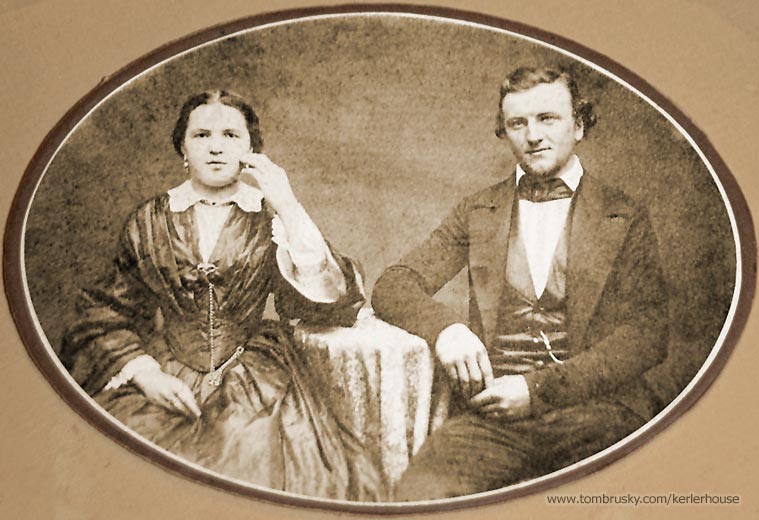
In 1857,
Louis Kerler married Wilhelmine Deeg, also a Bavarian immigrant. They
had twelve children between 1858 and 1879. Wilhelmine died in 1887 at
the age of 48. Photo supplied by Bill Gutknecht.
|
Over the last half of
the 19th century, the Kerler farms prospered. Edward, Louis, Henry
Frank, Henry Kroening, their families and hired hands worked hard.
Although Louis and Wihelmine had
many children, half of them
never married. William, August, Clotilda, Edward, Regina, and Louis
remained single and lived
on their father's farm well into the 20th century.
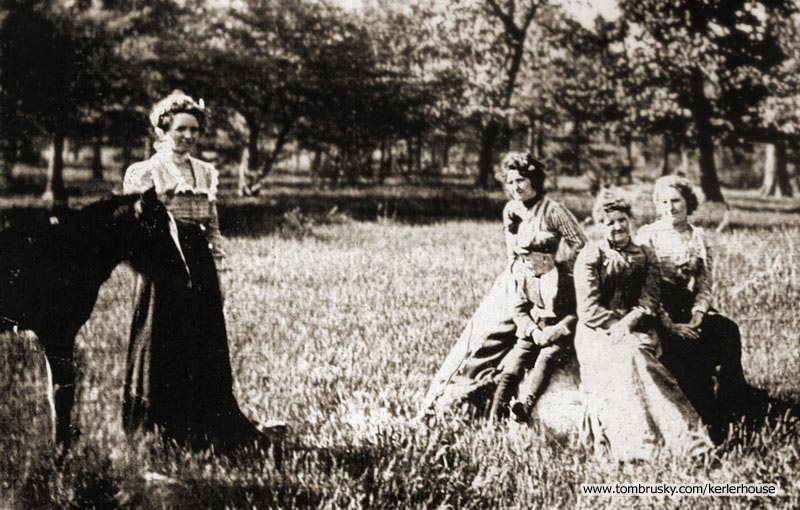
Photo
(cir.1900?) of Marie Kroening, (boy unknown), Regina Kerler, Clotilde
Kerler, Emma Kurtze. The photo was likely taken in the picnic area of
the farm, a picturesque woodland that existed around what is now 101st
& Norwich. It was a popular destination for visitors to the farm.
Photo supplied by Bill Gutknecht.
|
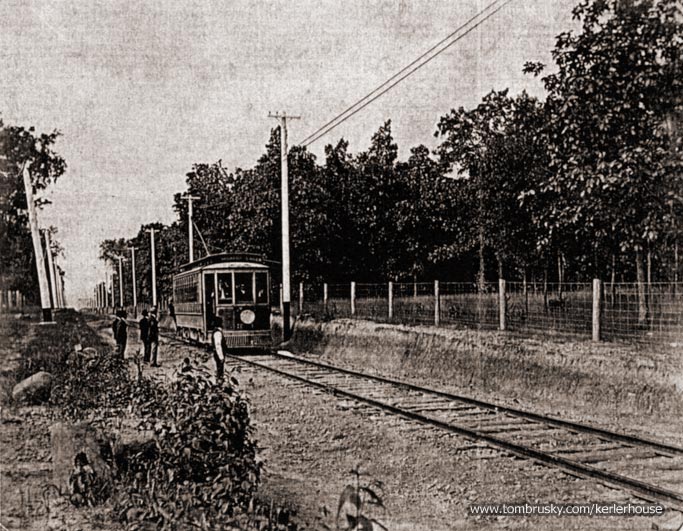
An
electric street car route ran along the east side of the Kerler
property. This photo (cir. 1915?) was taken near the Kerler Woods.
Fifty years later, the I-894 bypass replaced these tracks. Photo
supplied by Bill Gutknecht.
|
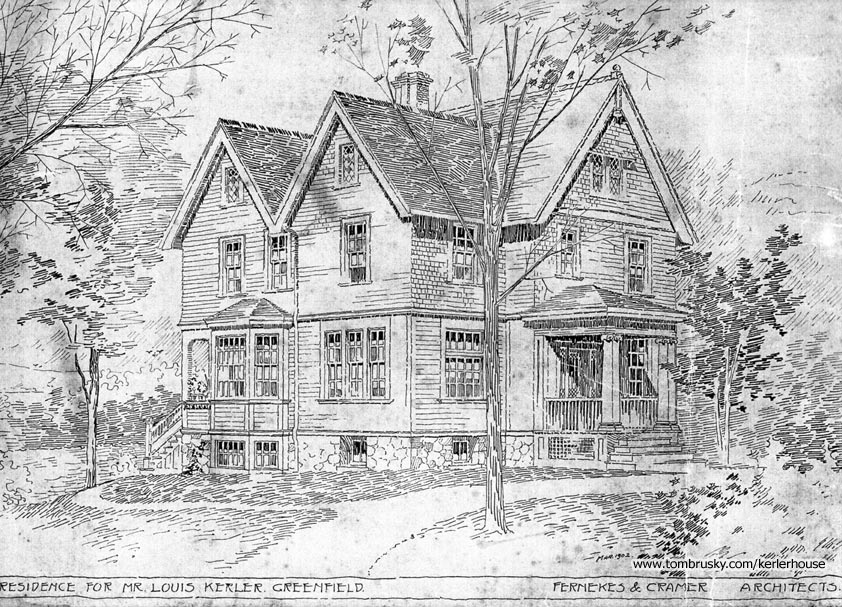
Around this time, Louis Kerler decided to have a new house built. His
hired his architect cousin, Max Fernekes, to design the house. In
March of 1902, the Milwaukee architectural firm of Fernekes &
Cramer completed this design for Louis' new house.
Max
Fernekes and Edwin Cramer had a prestigious architectural business
located in the former Pabst Building in Downtown Milwaukee. From 1900
to 1919, they designed stately homes and mansions as well
as several downtown commercial buildings. Architectural drawing
supplied by Bill Gutknecht.
|
In
the same Memoirs of Milwaukee County article, the
author wrote, "In 1904, Mr. Kerler built a fine, new
residence, where he anticipates living out the balance of his eventful
life."
Records at the City of Greenfield tax assessor's office confirmed the
1904 build date.
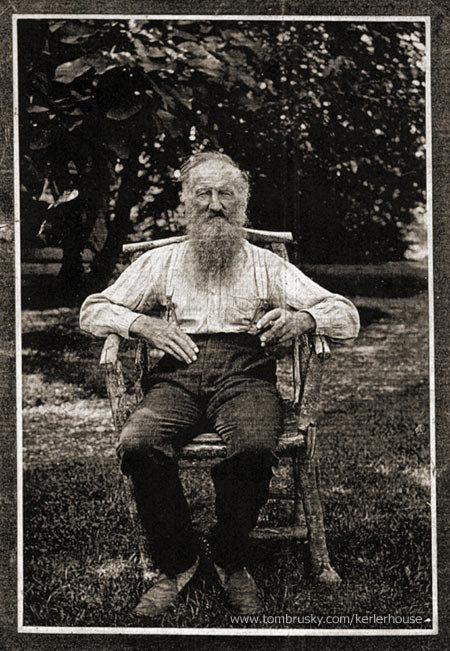
Louis Kerler, nicknamed the "American Tolstoy",
was 75 when he built his new house. He would only spend the
next six years there. He died in 1910. Photo supplied by Bill Gutknecht.
|
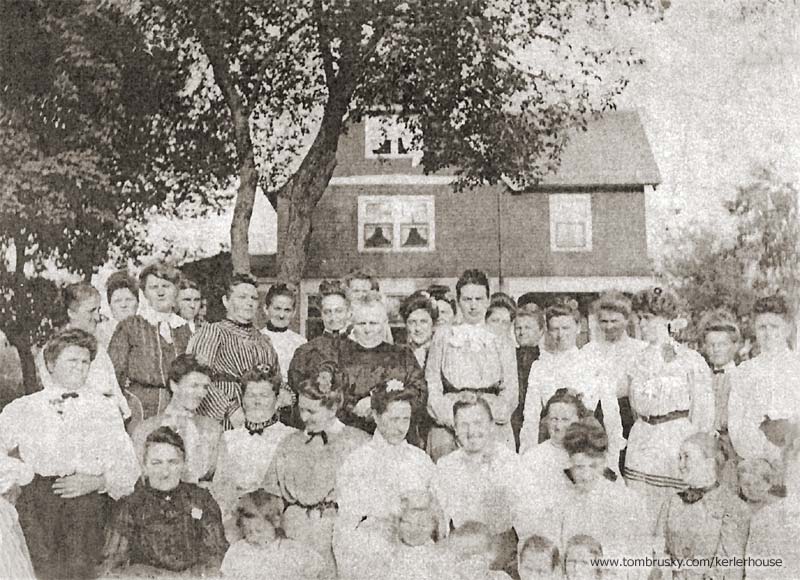
The
Ladies' Aid Society from Emmanuel Church, Hales Corners, gathered in
front of
Louis Kerler's newly-built house. Photo supplied by Sonsheree Kroening.
|
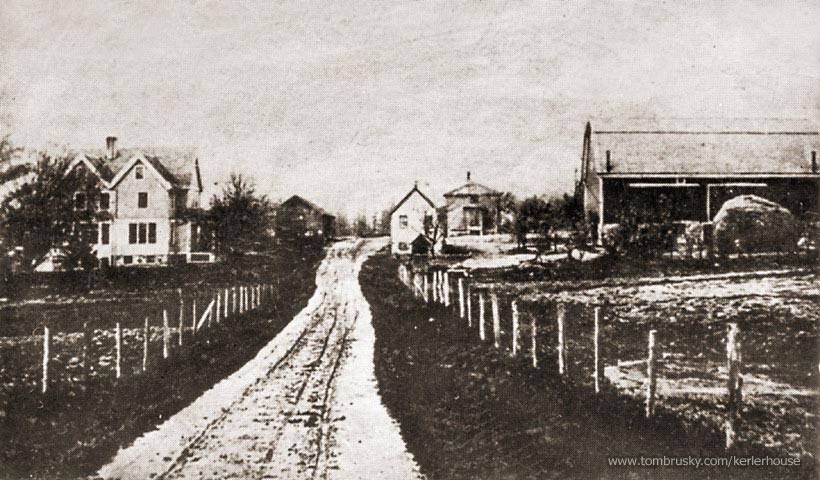
| The
Kerler
Farm around 1912. Louis Kerler's 1904 house is on the left. The square
house way in the background on the right is Louis' 1853 house. It was
orignally built on the
site of his 1904 house, but was relocated to the place shown in
this photo to make room for the new house. This section of the
farm's lane was previously located about 250 feet to the east. It is
not known when or why it was shifted west, but one theory is that lane
adjustments over the years were relevant to changes in property
divisions. Photo
courtesy of the Greenfield Historical Society. |
When Louis Kerler built his house in
1904:
- Teddy Roosevelt was U.S. President.
- The Titanic
wasn't even an idea yet.
- Greta Garbo, John
Wayne, Ayn Rand, and Katharine Hepburn were not yet born.
- World War I
wouldn't happen for another thirteen years.
- The Panama Canal
was ten years away from completion.
- No one had yet
heard of Albert Einstein's Theory of Relativity.
- Model T cars
would not hit the road for another four years.
- Orville and
Wilbur Wright's historic first flight was current news.
- Puccini's Madame Butterfly was making it's
debut in Milan, to no great reception.
- The only thing
Glenn Miller was arranging was his diapers.
- No one had yet
heard a radio station broadcast.
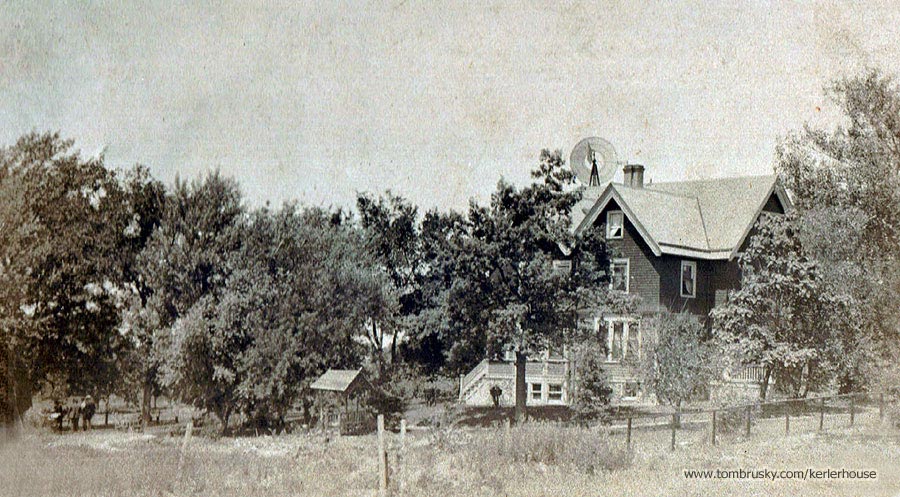
The
windmill behind the house operated a well inside a 15' x 15' pump
house. The well has long since
been filled in, but its square, concrete perimeter still exists to this
day. The well site is now
home to a large evergreen bush. Photo supplied by Frank Baldwin.
|
After
Louis Kerler died, his son, William, became the "boss" of the
family. William
changed the appearance of the house by replacing the original wood
siding with a shingle-like, fake brick. It was not a unanimously
popular decision.
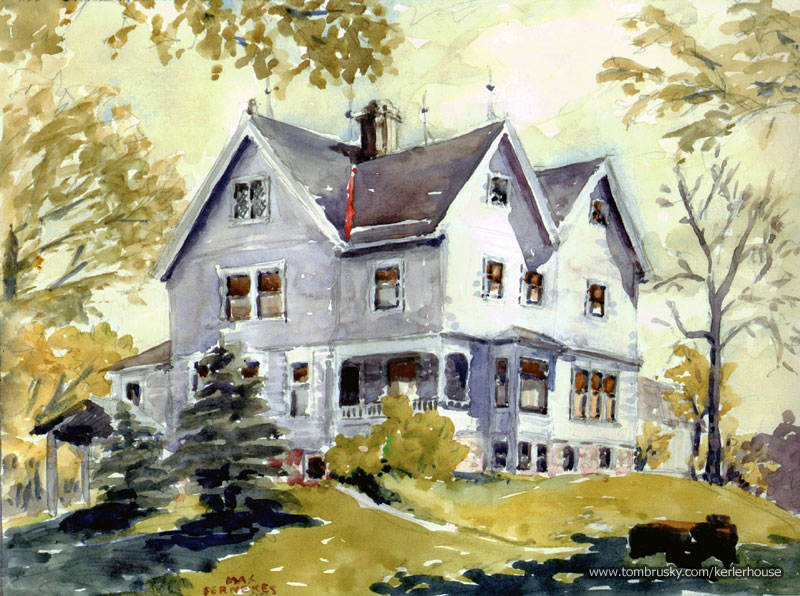
Watercolor
painting of the Kerler House (cir. 1929) by Max Fernekes, Jr.
(1905-1984),
son of Max
Fernekes the
architect. Notice the prominent lightning rods on the roof. Lightning
rods of the day had glass balls on them that were designed to shatter
in the event of a strike so that the building owner would know where to
check for possible damage. Artwork supplied by Frank Baldwin.
|
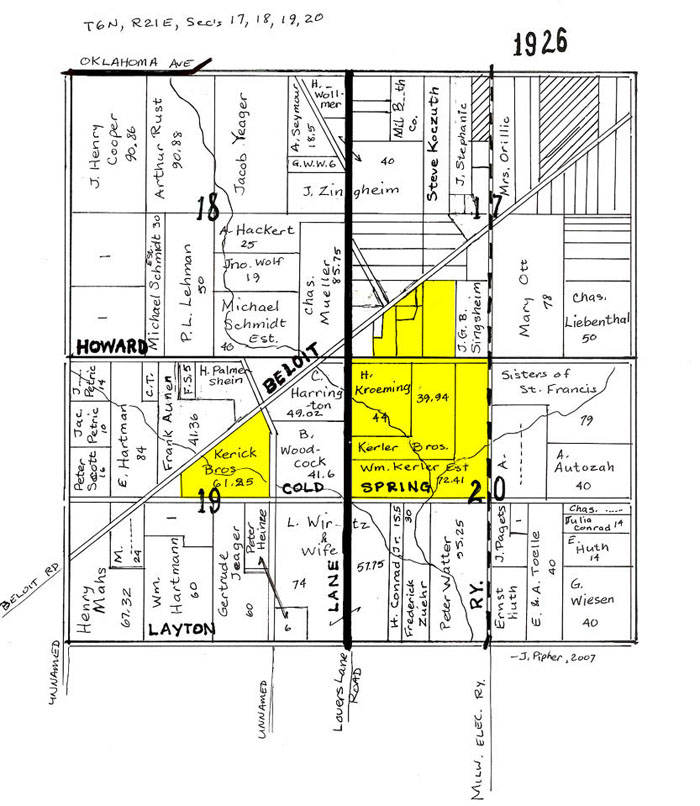
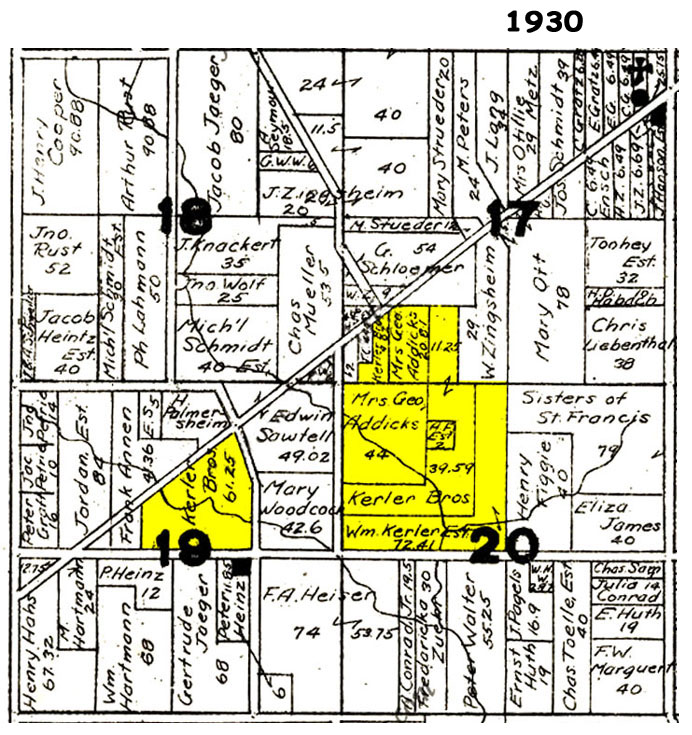
The land plats below show how the
property changed hands within the
family in the 1920's.
Note the misspellings: "Kerick Bros."
should say "Kerler Bros.", and "Kroeming"
should say "Kroening".
The H. Kroening mentioned on the plat is Henry Frederick Kroening,
husband of Marie Kerler.
Plat courtesy of the Greenfield Historical Society.
The Mrs.
Geo Addicks mentioned on the plat is Mathilda Kerler Addicks, Edward'
Kerler's daughter.
Plat courtesy of the Greenfield Historical Society.
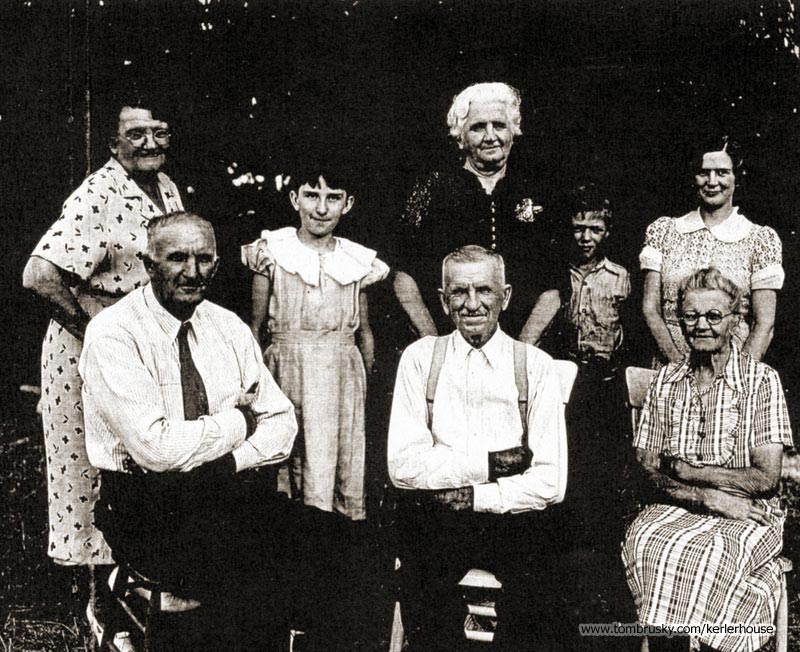
Photo
cir. mid 1930's: Standing — Regina Kerler, Mary Kroening, Emma Kurtze,
(boy unknown), and Louise Kurtze. Seated — Louis Kerler, William
Kerler, and Veronica Muehl. Photo supplied by Bill Gutknecht.
|
By the 1930's, the Kerlers were up in
age and no longer able to handle the heavy labor of farming, so they
decided to bring in a tentant farmer. In 1935, the Kerlers built a new
house on their property next to theirs. This new house would be a
residence for the tenant farmer and his help.
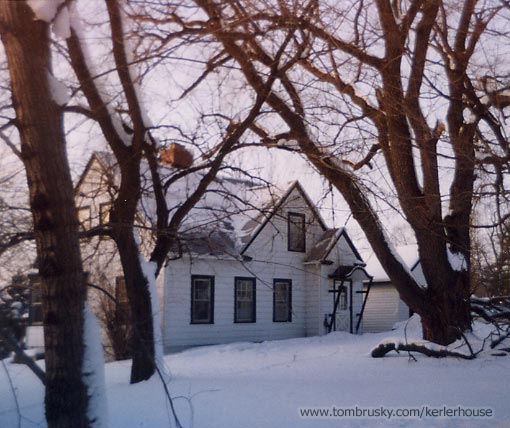
The
tenant farmer's house built in 1935, located at what is now 4045 S.
103rd Street. The name of the first tenant is
unknown, but in the 1940's, Fritz and Ruth Gutknecht moved onto the
farm and became
the tenants. Ironically, the house's current residents are Gutknechts,
but of no relation to the Kerler lineage. This photo
was taken in 1998, a few years before the massive willow tree on
the right – possibly the largest tree that ever grew in neighboorhood –
was cut down.
|


|